
Opens in a new tab
PexLens logo
PexLens logo
Pricing
Add your offcanvas content in here

DEVELOPER ENVIRONMENT SECURITY

Secure the machine
where code is written.
Developers install packages, dependencies and extensions dozens of times a day, on endpoints no scanner watches. PexLens checks every one of them at the moment of request — and stops the malicious ones before they execute.
Request a Demo
Secure the machine where code is written: PexLens developer environment security illustration
Four surfaces
packages, dependencies, IDE, browser
Same commands
no new developer workflow
Checked before execution
not after the install lands

THE GAP

Supply chain security stops at the pipeline.

Build systems are scanned, registries are mirrored, releases are signed. Meanwhile a developer installs an unreviewed package on a laptop with production credentials on it, and an install script runs before any of that applies.
EXECUTES FIRST

Code runs at install time

Post-install scripts execute the moment a package is fetched — long before review, CI or a scan.
HIGHEST PRIVILEGE

The richest machine in the org

Source, tokens, cloud sessions and SSH keys sit on the same endpoint that pulls untrusted code.
UNSEEN

No inventory of what landed

Most organizations cannot say which packages or extensions are on which developer machine today.
What we secure

Three ways software gets onto a developer machine

All three are covered by the same agent and the same policy — so there is no surface with a different rule.
COVERAGE

Four seconds, four checks, one verdict
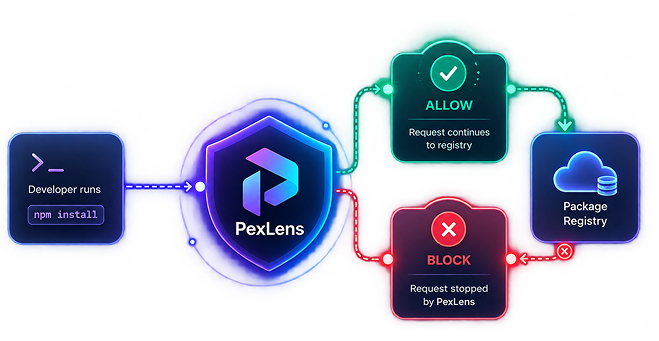
Ecosystems and platforms to confirm with product before launch.
Four seconds, four checks, one verdict: PexLens developer environment security illustration
COVERAGE

Where it works today

Ecosystems and platforms to confirm with product before launch.
What security sees

An inventory of every developer machine
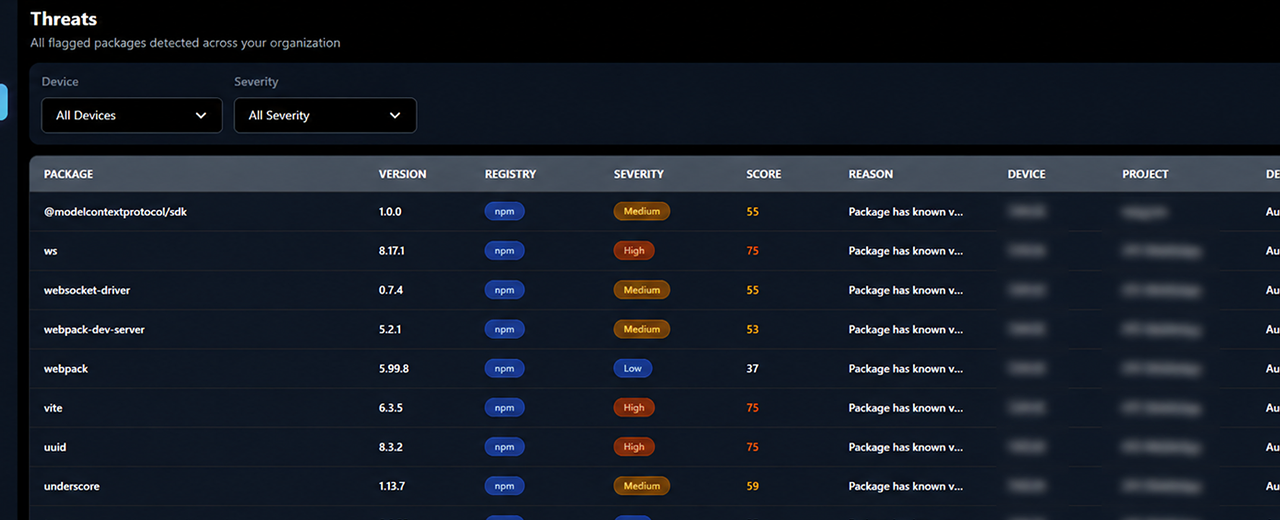
Which packages and extensions are installed on which device, requested by whom, with the verdict and the reason attached — so the question "what is on our developers' laptops" finally has an answer.
Filter by device
Filter by ecosystem
Export for audit
An inventory of every developer machine: PexLens developer environment security illustration
START AT THE ENDPOINT

See what your developers installed this week.

Run PexLens on a handful of machines and we will walk you through what was requested, what would have been blocked, and why.

FAQ

Developer environment security: common questions

Why secure the developer environment?

Developer machines hold source code, credentials and access to CI and cloud systems, so a malicious package, extension or AI tool installed there can reach far beyond one laptop.

Does PexLens cover AI coding assistants?

Yes. PexLens treats AI coding assistants and their extensions like any other component that enters the developer environment, and checks them for risky behaviour and changes.

What can security teams see?

An inventory of the packages, extensions and tools on developer machines, the risk of each, and every allow, alert or block decision.

Can PexLens stop developers pasting code or secrets into AI tools?

Yes, with AI Guard. It detects source code, secrets and API keys in prompts on the device and redacts or blocks them according to your policy.

What is PexLens Sentinel?

Sentinel is the PexLens component that runs on devices. It identifies installed packages, dependencies and extensions using package manifests and related technical signals, and keeps monitoring for changes in the background.

Can PexLens detect malicious VS Code extensions?

Yes. PexLens analyses VS Code and browser extensions for suspicious code, network activity, permission changes and publisher changes, and flags or blocks risky ones based on your policy.

View all FAQs →