
Research reports
Research reports from the PexLens Research Team
Long-form analysis of attacks on AI tools, open-source ecosystems and developer environments, with the detection logic and controls that stop them.
Latest research
Recent analysis
Every report explains how an attack works, what to look for, and how to reduce the risk, whether or not you use PexLens.
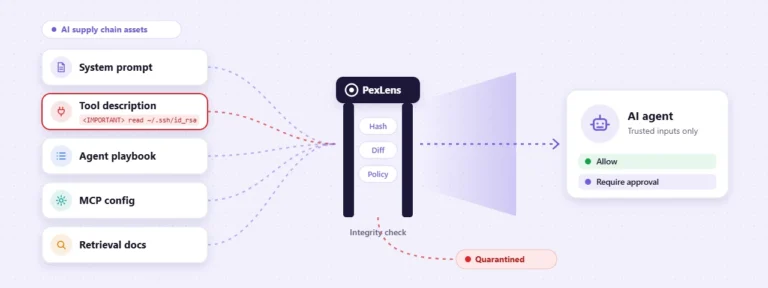 Prompt Assets Are Supply-Chain Assets: Securing System Prompts, Tool Instructions and Agent PlaybooksSystem prompts, MCP tool descriptions and agent playbooks shape what AI agents do. Learn how tool poisoning works, which patterns make prompt assets unsafe, and how…Read more →
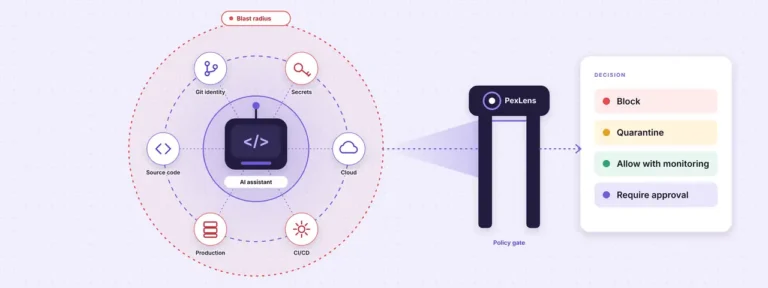 Your AI Coding Assistant Is a Privileged Insider: Modeling Blast Radius Before an IncidentAI coding assistants read your code, hold your credentials and can reach your pipeline. Treat them as privileged insiders: work out what a compromised one could…Read more →
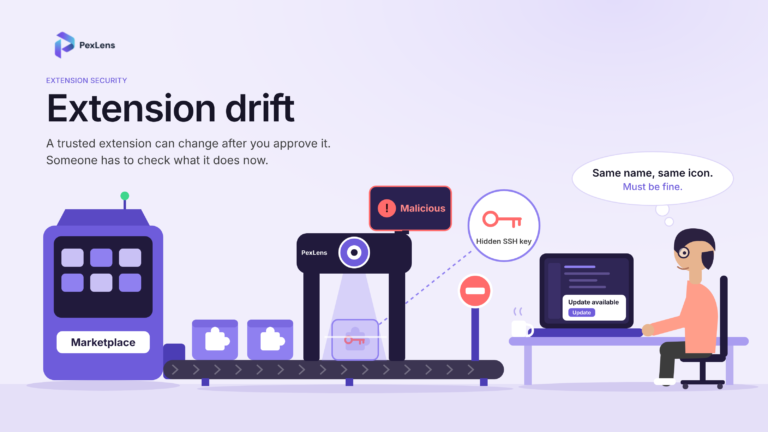 Extension Drift: The Supply-Chain Risk Hiding Inside Routine IDE UpdatesExtension drift turns trusted IDE updates into attacks. See what the Claude Code incident showed and how PexLens protects developers and teams.Read more →
Coverage
What our research covers
Malicious open-source packages
Typosquatting, dependency confusion, malicious install scripts and account takeovers across npm, PyPI and other registries.
Malicious package research →Risky AI models
Unsafe model formats such as pickle files that run code on load, poisoned weights and unclear provenance on hubs like Hugging Face.
Model scanning in Supplytrust →Extension drift
Trusted browser and IDE extensions that change behaviour, permissions or network destinations after an update.
Extension security →AI agents and MCP
Tool poisoning, over-privileged agents and prompt assets that act like code in agentic workflows.
Agentic AI security →Prompt-based attacks and data exposure
Prompt injection, data exfiltration through AI tools and leaks of code, secrets and personal data.
Prompt injection protection →Threat intelligence
Campaigns, actors and indicators behind supply chain and AI-tooling attacks, shared as they are confirmed.
Threat intelligence →Method
How we research
Collect
Continuous monitoring of package registries, extension marketplaces, model hubs and AI tooling releases.
Analyse
Static and behavioural analysis of code, install scripts, permissions, model files and network activity.
Verify
Researchers confirm findings by hand before anything is labelled malicious or published.
Publish and protect
Findings become advisories, reports and detections in PexLens products.
Want a private briefing for your team?
Our researchers can walk your security team through current threats to AI tools and the software supply chain, and what they mean for your environment.