Executive Summary
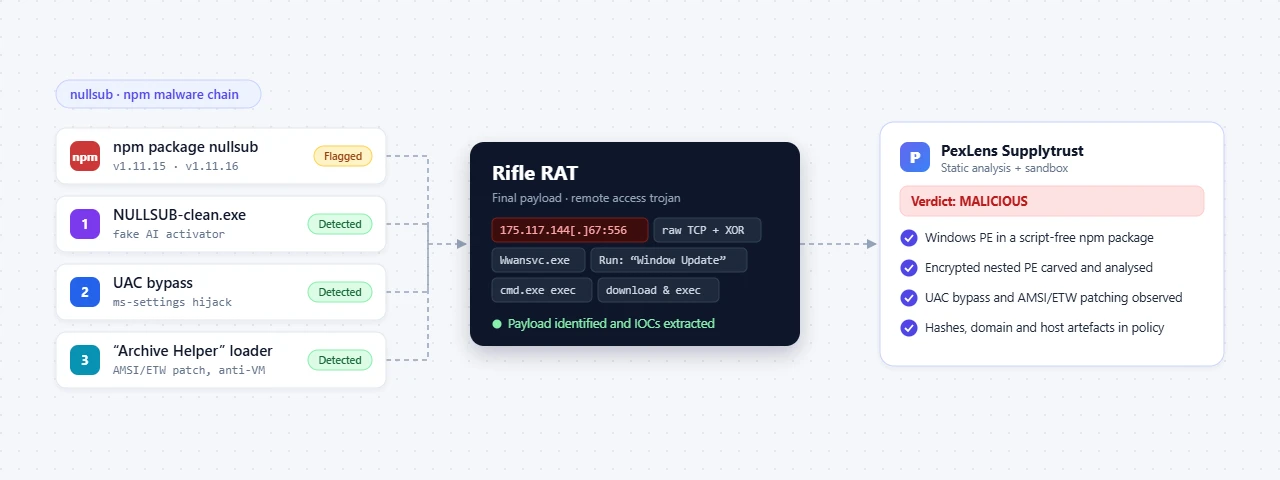
PexLens Supplytrust flagged the npm package nullsub as malicious. Package versions 1.11.15 and 1.11.16 ship an initial Windows downloader that fetches the real lure, NULLSUB-clean.exe, from ohnonoway[.]lol. That .NET program claims to be a free “activator” for paid AI, creative and developer subscriptions: ChatGPT, Claude, Claude Code, Cursor, Gemini, Copilot, Midjourney, Figma, Canva and about 30 more. While it was live, the package drew 472 weekly downloads; it has since been removed from the official npm registry.
The activator is fake. While its interface plays a scripted “patching” log and shows fake “activated” check marks next to each service, a background thread drops a second-stage loader, elevates it without a UAC prompt through the ms-settings / computerdefaults.exe hijack, and runs it. The loader blinds AMSI and ETW, fingerprints virtual machines, debuggers and sandboxes, then decrypts and launches the final payload: Rifle RAT, a backdoor that persists through Run keys and reports to a command-and-control (C2) server in South Korea.
The package has no install scripts and no JavaScript, so lifecycle-script scanners see nothing to block. The target audience is developers and AI power users who try to pirate AI tools. With a remote backdoor on such a machine, the operator can reach AI-service accounts, API keys and session tokens. Any machine that ran the package’s executable should be treated as fully compromised.
We analysed two builds of the NULLSUB .NET dropper: v1.13.2, which embeds the loader and works offline, and v1.11.14, which fetches it from ohnonoway[.]lol. Over the course of the campaign the dropper has handed out at least seven stage-2 loader builds, numbered Build_[14]_clr.exe through Build_[20]_clr.exe. In our sandbox the loader declined to decrypt its payload, but further analysis recovered it and identified the final payload as Rifle RAT, a backdoor first compiled in 2015 that is now delivered through a 2026 loader chain.
Key Findings
- npm as a malware shelf. nullsub 1.11.15 and 1.11.16 contain a Windows PE but no install script,
binentry or JavaScript entry point. Nothing runs onnpm install, so tools that only inspectpreinstall/postinstallhooks miss it. It reached 472 weekly downloads before npm removed it. When run, the PE downloads the .NET lureNULLSUB-clean.exefromhxxps://ohnonoway[.]lol/downloads/. - AI-tool piracy is the lure. The GUI detects which of ~35 AI and developer services are installed and pretends to unlock them. Its help text tells victims to ignore antivirus and SmartScreen warnings.
- Silent elevation. The dropper hijacks
HKCU\Software\Classes\ms-settings\Shell\Open\commandand launchescomputerdefaults.exe, so the payload starts at high integrity with no UAC prompt. The key is deleted about 12 seconds later. - Two delivery modes. v1.13.2 decrypts an embedded 1.25 MB resource (
NullSub.blob, 16-byte XOR key) and needs no network. v1.11.14 fetches an encrypted control file fromohnonoway[.]lolthat names the current payload URL and its SHA-256, so the operator can swap payloads without rebuilding the dropper. - A professional second stage. The dropped loader (posing as “Archive Helper 1.4 / Orbis Toolkit”) patches AMSI and ETW, checks for VMs, debuggers and sandbox clock skew, decrypts a ChaCha20-style payload and runs it in memory through a CLR host or donut shellcode, with Ekko sleep masking.
- Rotating, numbered loader builds. The dropper has delivered stage-2 loaders from
Build_[14]_clr.exeup toBuild_[20]_clr.exe. The numberedBuild_[N]_clrnaming points to a crypter or loader build system that is rebuilt and rotated regularly, typical of a loader-as-a-service operation. - Fast release cadence. New dropper builds shipped on 2026-11-06 and 2026-11-09. Each new version re-triggers the drop on machines that ran an older one.
- Rifle RAT as the final payload. In our sandbox the loader crashed before decryption, consistent with environment-keyed decryption. Further analysis recovered the third stage: Rifle RAT, a backdoor first compiled in December 2015 that talks to
175.117.144[.]67:556over raw TCP and persists through Run keys disguised as “Window Update”. The operator pairs this old backdoor with a new loader that supplies elevation and evasion.
Technical Analysis
NULLSUB is a multi-stage chain: an initial downloader shipped in the npm package, then the .NET WinForms lure-and-dropper NULLSUB-clean.exe (stage 1), a native x64 loader (stage 2), and Rifle RAT, a remote access trojan, as the final payload (stage 3). The diagram below shows the flow; each stage is explained after it.
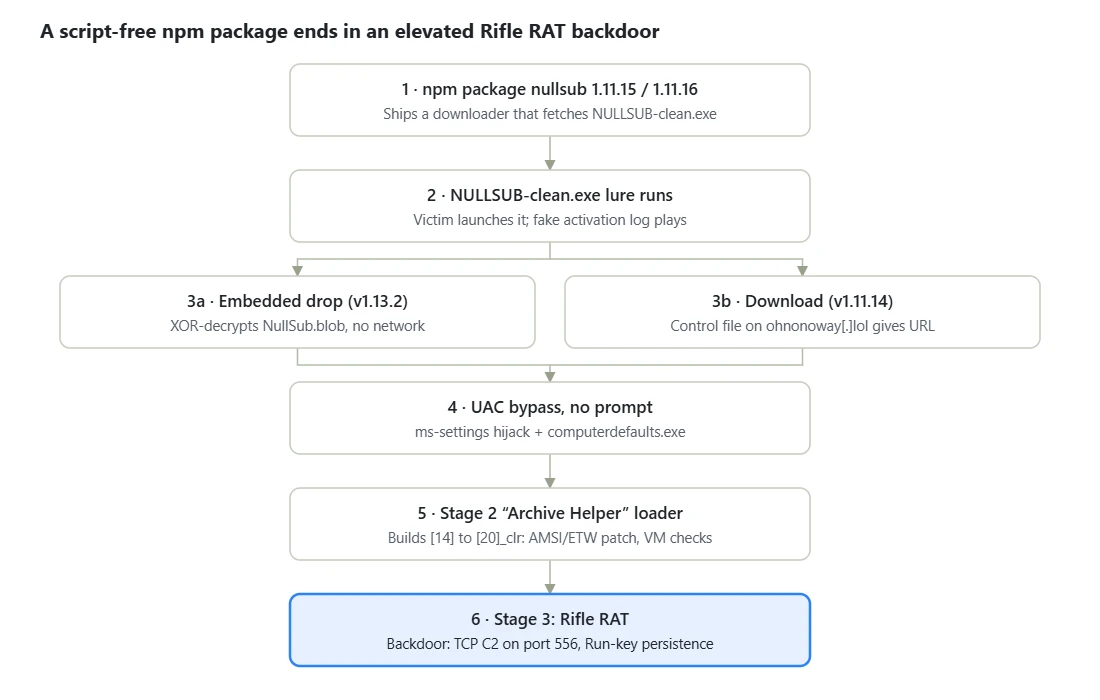
Both dropper builds converge on the same UAC bypass and the same stage-2 loader; only the way the loader arrives differs.
The npm package
| Package | Versions | Contents | Install scripts | Downloads |
|---|---|---|---|---|
nullsub (npm) | 1.11.15, 1.11.16 | Initial Windows downloader (PE) | None | hxxps://ohnonoway[.]lol/downloads/NULLSUB-clean[.]exe |
The executable in the package is only an initial downloader. When run, it fetches the .NET lure-and-dropper NULLSUB-clean.exe (stage 1), which then drops or downloads the stage-2 loader. Across the campaign the operator has served loader builds Build_[14]_clr.exe to Build_[20]_clr.exe; the build analysed in this post is Build_[20]_clr.exe.
Registry status. While nullsub was live on the npm registry it recorded 472 weekly downloads. It has since been removed from the official registry, so npm install nullsub no longer resolves. Copies can still sit in local npm caches, private registry mirrors and the node_modules folders of machines that installed it. npm download counts also include automated mirrors and security scanners, so 472 is an upper bound on real installs, not a victim count.
The version numbers of the NULLSUB program itself (1.11.14 and 1.13.2 in the samples below) are the lure’s own build numbers and are unrelated to the npm package versions.
Samples
| Sample | Version | Size | Type | Compiled (UTC) | Stage 2 delivery |
|---|---|---|---|---|---|
| Dropper A | NULLSUB 1.13.2 | 1,395,200 B | PE32 .NET 4.0 WinForms, unsigned | 2026-11-09 11:58 | Embedded, XOR-encrypted resource |
| Dropper B | NULLSUB 1.11.14 | 142,336 B | PE32 .NET 4.0 WinForms, unsigned | 2026-11-06 08:28 | Downloaded from C2 |
| Stage 2 loader | Build_[20]_clr.exe | 1,252,224 B | PE32+ x64, MinGW, 11 sections | 2026-03-19 04:51 | Dropped by A or B |
| Sample | SHA-256 | ImpHash |
|---|---|---|
| Dropper A | bbacf67f2914d0098a078a8ad8a749043b22d4607e2af353a043ba7ae7f0c588 | f34d5f2d4577ed6d9ceec516c1f5a744 |
| Dropper B | a8f05cc72ee6258a432c0b90f2c4810ebed22a26d862f572441cfcbcacdd53b7 | f34d5f2d4577ed6d9ceec516c1f5a744 |
| Stage 2 loader | 6fa2c177d6fef3efb1704d4fd375c617498313d5b62f2545c39578bd86993c36 | d8c88bbb18ac12b5b94168affce6516f |
The droppers are not packed or obfuscated, so class names and strings decompile cleanly. All evasion lives in stage 2.
Stage 1: the .NET lure and dropper (NULLSUB-clean.exe)
1.1 Lure interface
Det.Scan() enumerates running processes and the three Uninstall registry hives to show which AI services are installed. Clicking a service only plays a scripted log (“seeding identity… entitlement granted… ACTIVE”). Nothing is unlocked.
The config header says leaving relay_url empty keeps the tool offline, and the help text claims everything happens on the local PC. Both are false: the payload thread runs regardless of configuration.
| Artefact | Value | Purpose |
|---|---|---|
| Mutex | NullSub.<version> | Single instance per build |
| Window message | NULLSUB_SHOW | Re-activates the first window on a second launch |
| Config file | nullsub.cfg beside the exe | Overrides payload source, keys, delay and clean-up |
| Fake licence | NS2K4-9QX7M-4F19C-0DEAC-TV000 | Pre-filled with a “GEN” button and fake HWID binding |
| Help text | “it is unsigned, allow it”; “SmartScreen: More info, Run anyway” | Pre-empts antivirus and SmartScreen warnings |
1.2 Background payload thread
About four seconds after launch (payload_delay=4), SchedulePayload starts RunPayloadOnce in the background.
| Control | Location | Behaviour |
|---|---|---|
payload.flag | %LOCALAPPDATA%\nullsub\ | Stamped with the dropper version, so every new build runs the payload again |
payload.try | %LOCALAPPDATA%\nullsub\ | Limits retries to once per hour |
--payload switch | Command line | Bypasses both guards |
payload_keep=0 | nullsub.cfg | Deletes the dropped payload 25 seconds after it starts |
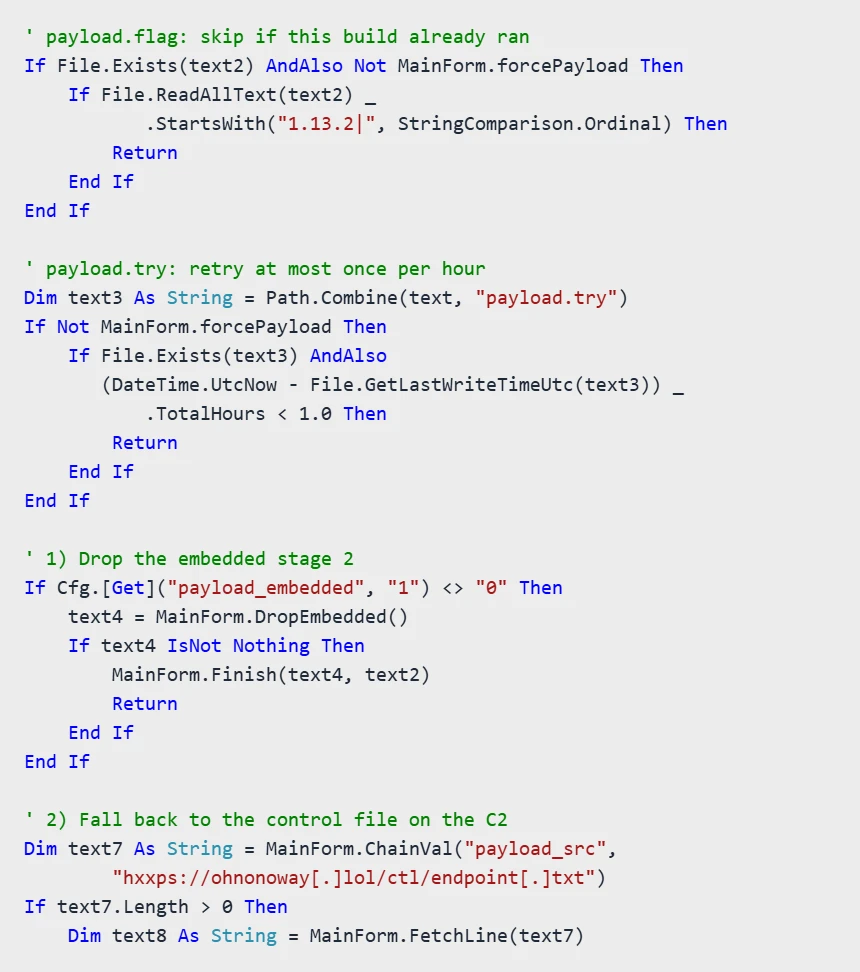
payload.flag), retries at most once per hour (payload.try), drops the embedded stage-2 loader, and otherwise falls back to the endpoint.txt control file on the C2 server.1.3 Stage 2 delivery
| Mode | Used by | Source | Decryption | Notes |
|---|---|---|---|---|
| Embedded drop | v1.13.2 (default) | Manifest resource NullSub.blob, 1,252,224 B | XOR, 16-byte key 3d06a73c50937da7422fceb90833664f; must start with MZ | No network needed |
| Control file | v1.11.14; v1.13.2 fallback | hxxps://ohnonoway[.]lol/ctl/endpoint[.]txt | Hex text, XOR key 7d9b59c2cce54c0e5e3223a8, yields url|sha256 | Operator can rotate the payload URL without a rebuild |
| Direct URL | Fallback | hxxps://ohnonoway[.]lol/dl/upd[.]bin | XOR key 3d06a73c...664f, optional SHA-256 pin | Staged as a .part file |
Requests use a hard-coded Chrome 131 User-Agent with the site origin as Referer. The payload is written to %LOCALAPPDATA%\nullsub\runtime\ under a service-like name such as host-9d2d.exe.
Through this delivery channel the operator has served successive loader builds, from Build_[14]_clr.exe up to Build_[20]_clr.exe, without changing the dropper. Each build carries the same loader design with a fresh encrypted payload resource.
Decoding the control file. The body of endpoint.txt is a hex string. Converting it to bytes and XORing them with key 7d9b59c2cce54c0e5e3223a8 gives the next-stage URL, hxxps://ohnonoway[.]lol/dl/upd[.]bin, followed by the SHA-256 the dropper expects that file to have: 6FA2C177D6FEF3EFB1704D4FD375C617498313D5B62F2545C39578BD86993C36.
The pinned hash belongs to Build_[20]_clr.exe, the loader analysed in this post. The copy of upd.bin we retrieved is 1,308,968 bytes, larger than that build’s 1,252,224 bytes, so the server had most likely already moved on to a newer loader build. It XOR-decrypts with key 3d06a73c50937da7422fceb90833664f into a Windows executable with a valid MZ header.
1.4 UAC bypass launch
LaunchElevated runs the payload at high integrity without a UAC prompt:
- Writes the payload path as the default value of
HKCU\Software\Classes\ms-settings\Shell\Open\commandand sets an emptyDelegateExecutevalue. - Starts
computerdefaults.exehidden. This Microsoft binary auto-elevates and follows the hijacked handler. - Waits 8 + 4 seconds, then deletes the registry key.
- If that fails, tries the
runasverb, thenexplorer.exe.
A helper can also strip the :Zone.Identifier stream (Mark-of-the-Web). The bypass works only when the user is a local administrator with UAC at its default level.
Stage 2: the “Archive Helper” native loader
2.1 File profile
| Property | Value |
|---|---|
| Original name | Build_[20]_clr.exe (dropped as host-<4 hex>.exe) |
| Compiler | MinGW/GCC, x64, 11 sections, TLS callback |
| Version resource | “Archive Helper 1.4”, “Orbis Toolkit”, “(C) 2024” (fake) |
| Encrypted payload | 1,156,096-byte .rsrc section, entropy 7.98 |
| Logging | Verbose OutputDebugString lines, which our sandbox captures in full |
2.2 Capabilities
| Capability | Evidence |
|---|---|
| AMSI and ETW blinding | Patches AmsiScanBuffer, AmsiScanString, AmsiOpenSession, EtwEventWrite, EtwEventWriteFull and advapi32!EventWrite; logs [patch] ... stomped |
| VM detection | VMware, VirtualBox, QEMU, Parallels and Xen processes and drivers, CPUID hypervisor bit, MAC OUI, firmware tables |
| Debugger detection | PEB flags, CheckRemoteDebuggerPresent, NtQueryInformationProcess, heap flags, timing, and names such as x64dbg, dnSpy, IDA and WinDbg |
| Sandbox detection | sandbox:clock-skew: compares requested sleep against wall clock, tick count and TSC |
| Payload decryption | Salsa20/ChaCha constant expand 32-byte k, per-chunk CRC32, FNV and API hashing; the key appears to depend on the environment checks |
| In-memory execution | In-process CLR host (CLRCreateInstance, AppDomain, entry-point invoke), manual PE mapper, donut runner, temp-file fallback |
| Sleep obfuscation | Ekko-style timer-queue ROP that encrypts the image while it sleeps |
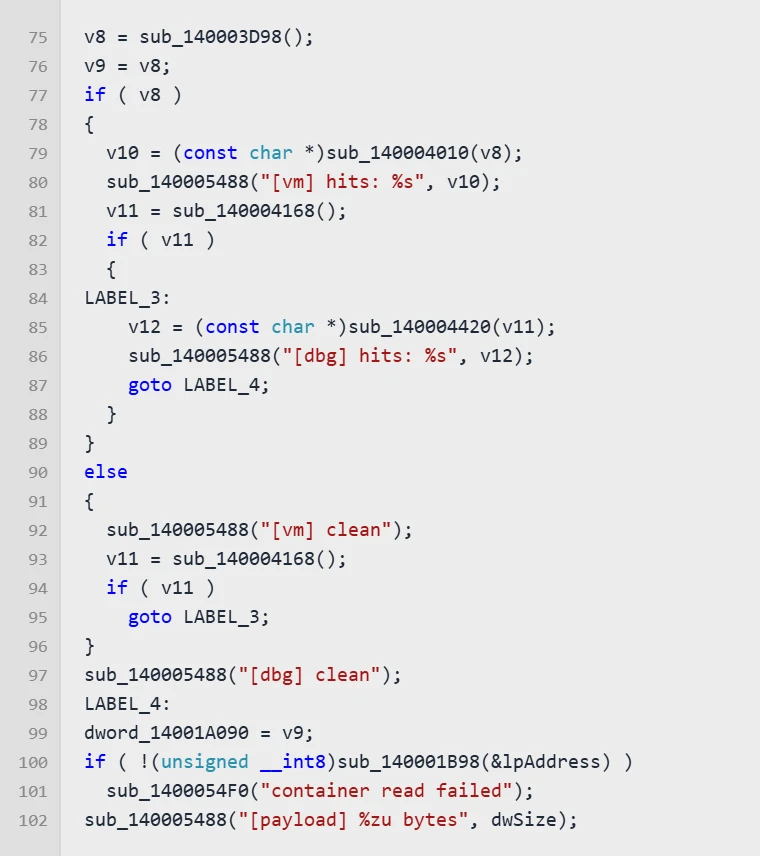
[vm] hits or [vm] clean, [dbg] hits or [dbg] clean), then reads the encrypted payload container and logs its size.2.3 Sandbox behaviour
| When | Observation |
|---|---|
| ~25 s | Dropper A writes %LOCALAPPDATA%\nullsub\runtime\host-9d2d.exe; its hash matches the decrypted NullSub.blob |
| ~25 s | Loader launched elevated through the ms-settings hijack; the key is deleted afterwards |
| Stage 2 start | Loader patches AMSI and ETW, reports [vm] hits: cpuid hv mac drv proc and [dbg] hits: heap timing |
| Before decryption | Reads a 1,043,968-byte payload and starts its Ekko worker |
| ~55 s | Crashes with an access violation (0xC0000005 at +0x3108); no [crypto] decrypted line, no decrypted PE in the dump |
Dropper B, --payload | Debug log confirms both C2 URLs; the domain does not resolve without internet access |
| Whole run | No persistence from stage 1 or 2; no outbound traffic from stage 2 |
The crash inside the sandbox is most likely environment-keyed or deliberate fail-closed behaviour on virtual machines, though an ordinary bug is possible. The third stage was recovered outside the sandbox run (see Stage 3).
Stage 3: Rifle RAT
Stage 2 decrypts the final payload and launches it through one of its execution paths: the in-process CLR host, the manual PE mapper, the donut runner or the temp-file fallback. Our sandbox run ended before this step, but further analysis recovered the payload and identified it as Rifle RAT.
Rifle RAT is an older native backdoor, first compiled in December 2015 with Microsoft Visual Studio 2010, and it has been covered in earlier public reporting. We therefore summarise only what matters for this campaign: an old backdoor does the remote control, while the 2026 loader supplies elevation, AMSI/ETW blinding and anti-analysis.
| Aspect | Detail |
|---|---|
| C2 | 175.117.144[.]67 on TCP port 556 (AS9318, Korea Telecom, South Korea) |
| Protocol | Raw TCP encrypted with a custom XOR stream cipher; fixed seeds 0x1A2C and 0x4C5B, reset for every session (decoder in Appendix A) |
| Capabilities | Remote command execution through a hidden cmd.exe with piped output; file download and execution ($download, $downloadexec, default file name sec.exe); system reconnaissance |
| Persistence | Copies itself to C:\ProgramData\Update\Wwansvc.exe (HKLM Run) and C:\Program Files\Common Files\Update\Wwansvc.exe (HKCU Run); value name Window Update, launch argument /run |
| Evasion | Anti-debugging through rapid GetTickCount checks; deletes its original file with cmd /c del /q after installing |
| Build artefact | PDB path C:\Users\C8\Desktop\rifle\Release\rifle.pdb (user name C8) |
| SHA-256 | eec4860a0052d21579dcbd82874a7a3dc4cd9312d11ce429326225c8492fd482 |
| SHA-1 / MD5 | 68d9dc07c9ce5764b1beb8a0ddd3c4166e7fdc38 / 0dda14fd7aaee7c0c6b36e4e71f95406 |
Both persistence names imitate Windows: Wwansvc.exe borrows the name of the WWAN AutoConfig service, and “Window Update” resembles Windows Update. Writing the HKLM Run key needs administrator rights, which the NULLSUB chain has already obtained through the UAC bypass. For victims who pirate AI tools, remote command execution and download-and-execute give the operator a direct path to AI-service accounts, API keys, .env files, browser sessions and wallets, and a way to deploy further tools.
How PexLens Detected nullsub
PexLens Supplytrust flagged nullsub as malicious on both its static engines and its sandbox. No single signal made the call: the verdict came from independent signals that agreed at each stage. This matters for packages like nullsub, because a scanner that only reads package.json scripts sees a harmless, script-free package.
The staged pipeline
- Manifest and metadata triage. The package declares no lifecycle scripts,
binormainentry, yet its tarball contains a Windows PE. A PE in an npm package with no JavaScript that could use it is anomalous by itself. Combined with a new or low-reputation publisher, it raises the package’s priority. - Binary static analysis. PexLens parses every PE in the tarball. The nullsub executable is a downloader that points to
hxxps://ohnonoway[.]lol/downloads/NULLSUB-clean[.]exe, so that next stage is retrieved and analysed as well. It is an unsigned .NET WinForms binary with readable strings: the C2 domain, XOR keys, thems-settingsregistry path,computerdefaults.exe,:Zone.Identifierand payload-staging config keys. - Decompilation and resource carving. The .NET layer is decompiled and manifest resources are extracted.
NullSub.blobdecrypts with the hard-coded 16-byte key into an MZ image. That nested PE then goes through the same static pass, which reveals AMSI/ETW patch strings, VM and debugger checks, the ChaCha constant and the CLR-host loader. - Static rule correlation. PexLens static rules cover the dropper, the stage-2 loader and the config file. Each rule needs several co-occurring indicators, not one string, which keeps false positives low.
- Sandbox detonation. The executable runs in an instrumented Windows sandbox. Within about 30 seconds it shows the behaviours that decide the case: a file written under
%LOCALAPPDATA%\nullsub\runtime\, the transientms-settingshijack key, a hiddencomputerdefaults.exe, a high-integrity child process from a user-writable path, and in-process AMSI/ETW patching. - Verdict. Static intent (dropper and UAC-bypass code), static capability (an evasive loader nested inside) and dynamic confirmation (elevation and defence impairment observed) all agree. The package is classified malicious, and its hashes, domain and host artefacts are pushed to customer policy.
Signals that decided the verdict
| Stage | Signal | Why it matters |
|---|---|---|
| Metadata | Native PE in a package with no JS and no scripts | npm used as a carrier, not as a library |
| Static | ms-settings\Shell\Open\command + computerdefaults.exe in the same binary | Known UAC-bypass pair (T1548.002) |
| Static | Hard-coded XOR keys, payload URL and SHA-256 pin logic | Downloader and dropper intent |
| Static | Nested PE in an encrypted resource, .rsrc entropy 7.98 | Hidden second stage |
| Static | AMSI/ETW function names next to patch log strings | Defence impairment (T1562.001) |
| Sandbox | Registry hijack created and deleted within ~12 s | Anti-forensics around elevation |
| Sandbox | High-integrity process started from %LOCALAPPDATA% via computerdefaults.exe | Elevation confirmed |
| Sandbox | VM, debugger and clock-skew checks, then a crash before decryption | Evasive, environment-aware loader |
Making detection stick for this class of package
nullsub shows a gap in common npm scanning: if nothing executes on install, many tools stop looking. PexLens applies these controls to binary-carrier packages:
- Treat any PE, ELF or Mach-O file in a package as content to analyse, whether or not
package.jsonreferences it. - Recurse into embedded resources and try simple decoders (single- and multi-byte XOR, base64, gzip) to surface nested executables.
- Score the mismatch between what a package declares (no scripts, no entry point) and what it ships (an executable).
- Detonate in a sandbox that hides VM artefacts (CPUID hypervisor bit, VMware/VirtualBox drivers and processes, MAC OUI, firmware strings), so environment-keyed loaders like this one reveal their final payload.
- Track the campaign, not the version: the ImpHashes
f34d5f2d...andd8c88bbb..., the C2 domain, the mutex pattern and theBuild_[N]_<flavour>naming are stable across rebuilds.
How an EXE-only npm Package Still Gets Executed
npm never runs a bundled executable on its own. npm install only downloads and extracts the tarball. Without lifecycle scripts, a bin entry or JavaScript that spawns it, the bundled downloader just sits in node_modules/nullsub/. (The registry requires a package.json to publish, so “no JSON” in practice means a bare manifest with name and version and no scripts, bin or main.)
The package is still dangerous, because the attacker does not need npm to run the file. These are the realistic paths, most likely first.
1. npm as free, trusted file hosting
Every file in a published package gets a stable public URL on the registry tarball endpoint and on public npm CDNs such as unpkg and jsDelivr. A lure site, a YouTube description, a Discord or Telegram post, or another dropper can link straight to the bundled executable on one of those domains.
Those domains are widely allow-listed in corporate proxies and rarely blocked by web filters, so the download looks like ordinary developer traffic. In this model the npm package is not the infection vector; it is the attacker’s hosting. This is the most likely reason for a binary-only package, and it is why removing it from the registry also removes the CDN copies.
2. Social engineering the installing user
The target audience already wants to run a “free activator”. The package README or a lure page can tell the victim to run npm i nullsub and then open the executable inside node_modules\nullsub\. Once the downloader has fetched the lure, its help text pre-empts warnings with lines like “it is unsigned, allow it” and “SmartScreen: More info, Run anyway”.
Files extracted by npm usually carry no Mark-of-the-Web, because MOTW is added by browsers and mail clients, not by package managers. A file launched from node_modules may therefore skip the SmartScreen and “downloaded from the internet” checks that a browser download would trigger.
3. A second package does the launching
The attacker can split the attack across packages. A second, harmless-looking package lists nullsub as a dependency and, from its own install hook or runtime code, resolves the path to the executable under node_modules/nullsub/ and spawns it. Each package looks incomplete on its own: one ships a binary and no code, the other ships a few lines of path resolution and a child_process call.
Scanners that judge each package in isolation can clear both. Detection needs dependency-graph analysis: a package that spawns a file from another package’s directory is a strong signal.
4. A later version arms it
A script-free first version builds download count and a clean scan history. A later release can add a postinstall, bin or main entry that runs the binary already in the package, or swap the binary. Version-diff analysis catches this: the moment a package gains an execution path to a native executable is the moment to block it.
5. Manual or tooling execution on Windows
A developer browsing node_modules in Explorer, an IDE “open file” action, or a build tool told to run every .exe in a folder can launch it by accident. This is the least targeted path, but it needs no attacker infrastructure.
What this means for defenders
A binary-only package’s risk depends on what it ships, not on what its manifest says. Treat executables in packages as content to analyse, block packages that ship native executables without a reason, and alert on any process started from under node_modules that is a PE rather than node.
Indicators of Compromise, ATT&CK Mapping and Recommendations
Network indicators (defanged)
| Type | Value | Note |
|---|---|---|
| Domain | ohnonoway[.]lol | Hosts the stage-1 lure, the control file and the stage-2 payload |
| URL | hxxps://ohnonoway[.]lol/downloads/NULLSUB-clean[.]exe | Stage-1 .NET lure-and-dropper, fetched by the downloader in the npm package |
| URL | hxxps://ohnonoway[.]lol/ctl/endpoint[.]txt | Encrypted control file, XOR key 7d9b59c2cce54c0e5e3223a8, content url|sha256 |
| URL | hxxps://ohnonoway[.]lol/dl/upd[.]bin | Stage-2 payload, XOR key 3d06a73c50937da7422fceb90833664f |
| IP and port | 175.117.144[.]67:556 (TCP) | Rifle RAT C2; AS9318 (Korea Telecom), South Korea; raw TCP with a custom XOR stream cipher |
| User-Agent | Mozilla/5.0 (Windows NT 10.0; Win64; x64) AppleWebKit/537.36 (KHTML, like Gecko) Chrome/131.0.0.0 Safari/537.36 | Hard-coded in the dropper, Referer set to site origin |
File hashes (SHA-256)
| File | SHA-256 |
|---|---|
| NULLSUB 1.13.2 (dropper A) | bbacf67f2914d0098a078a8ad8a749043b22d4607e2af353a043ba7ae7f0c588 |
| NULLSUB 1.11.14 (dropper B) | a8f05cc72ee6258a432c0b90f2c4810ebed22a26d862f572441cfcbcacdd53b7 |
Stage 2 Build_[20]_clr.exe | 6fa2c177d6fef3efb1704d4fd375c617498313d5b62f2545c39578bd86993c36 |
Encrypted resource NullSub.blob | e070a835718a1a20dabade974c186c0d93749a612478cbac84459cef52644f12 |
| Stage 3 Rifle RAT | eec4860a0052d21579dcbd82874a7a3dc4cd9312d11ce429326225c8492fd482 |
nullsub.cfg | 0d27cce0a57262eefcc110496ebd589c1030cbe31aa0855bafebe81aaa5c35c6 |
Related loader Build_[14]_0359193135_crypt.exe | 76272ea0f7880660df12a6deda355b11fdb8e47baae96abb68e7c5c286329a55 |
| Related dropper | 44e40463aef7430a6eb20d5ad67ad17139887feeb7a5e6ca797addff8d9fd2a6 |
| Related dropper | e817e71c1ccaadfe3a3781b49ba020cc9967309295af3f7099c25f53c6e40a74 |
Host indicators
| Type | Value |
|---|---|
| Mutex | NullSub.<major.minor.patch>, e.g. NullSub.1.13.2 |
| Window message | NULLSUB_SHOW |
| Folder | %LOCALAPPDATA%\nullsub\ with payload.flag, payload.try, dbg.txt, runtime\ |
| Dropped loader | %LOCALAPPDATA%\nullsub\runtime\{svc,upd,licensing,runtime,client,host}-<4 hex>.exe |
| Registry (transient) | HKCU\Software\Classes\ms-settings\Shell\Open\command with empty DelegateExecute |
| Process chain | NULLSUB-clean.exe → computerdefaults.exe (hidden) → %LOCALAPPDATA%\nullsub\runtime\*.exe at high integrity |
| Version info | “Archive Helper 1.4”, “Orbis Toolkit” |
| Rifle RAT files | C:\ProgramData\Update\Wwansvc.exe, C:\Program Files\Common Files\Update\Wwansvc.exe; downloaded payloads default to sec.exe |
| Rifle RAT Run keys | HKLM\Software\Microsoft\Windows\CurrentVersion\Run and HKCU\Software\Microsoft\Windows\CurrentVersion\Run, value Window Update, data "<path>\Wwansvc.exe" /run |
| Rifle RAT behaviour | Hidden cmd.exe with piped stdout/stderr; cmd /c del /q on its own path; outbound TCP to port 556 |
| Rifle RAT PDB | C:\Users\C8\Desktop\rifle\Release\rifle.pdb |
MITRE ATT&CK
| Tactic | Technique |
|---|---|
| Initial access | T1195.002 Compromise Software Supply Chain (npm carrier) · T1204.002 User Execution: Malicious File |
| Execution | T1620 Reflective Code Loading · T1106 Native API · T1059.003 Windows Command Shell (Rifle RAT) |
| Persistence | T1547.001 Registry Run Keys (Rifle RAT, “Window Update”) |
| Privilege escalation | T1548.002 Bypass User Account Control · T1112 Modify Registry |
| Defense evasion | T1562.001 Impair Defenses (AMSI/ETW) · T1027 Obfuscated Files · T1140 Deobfuscate/Decode · T1497.001 VM evasion · T1622 Debugger evasion · T1036 Masquerading (fake activator, “Archive Helper”) · T1036.005 Match Legitimate Name (Wwansvc.exe) · T1070.004 File Deletion · T1553.005 Mark-of-the-Web Bypass |
| Discovery | T1518 Software Discovery · T1057 Process Discovery · T1082 System Information Discovery |
| Command and control | T1105 Ingress Tool Transfer · T1071.001 Web Protocols · T1568 Dynamic Resolution · T1095 Non-Application Layer Protocol · T1571 Non-Standard Port · T1573.001 Symmetric Cryptography (Rifle RAT) |
Recommendations
- Block
ohnonoway[.]loland175.117.144[.]67(TCP 556) at DNS, proxy and firewall, and block the nullsub package in your npm proxy or registry firewall. - Hunt for a registry write to the
ms-settingscommand key followed bycomputerdefaults.exespawning anything other than SystemSettings; for high-integrity processes launched from%LOCALAPPDATA%\*\runtime\; for a Run value namedWindow Updatethat points toWwansvc.exe; and for outbound TCP connections to port 556. - Sweep endpoints for the
%LOCALAPPDATA%\nullsub\,C:\ProgramData\Update\andC:\Program Files\Common Files\Update\folders,nullsub.cfg,payload.flagand the hashes above, and check developer machines for the nullsub package innode_modules. - If a host ran it, treat it as fully compromised: isolate, capture memory, reimage, and rotate every credential reachable from it. Start with AI-service accounts and API keys (Anthropic, OpenAI, Cursor, GitHub Copilot), cloud keys, browser sessions, SSH keys and wallets.
- Harden: set UAC to “Always notify” or give developers standard-user daily accounts, and restrict execution from
%LOCALAPPDATA%andnode_moduleswith WDAC or AppLocker. - Educate: a “free activator” for a paid AI tool is malware, wherever it is hosted.
Conclusion
nullsub shows attackers using a package registry as trusted hosting for a Windows malware chain. The package runs nothing on install and contains no code, so script-focused scanners pass it. The executable inside it starts a chain that ends with an elevated, evasive loader and Rifle RAT, aimed at the developers and AI users whose credentials are now among the most valuable on any network. An eleven-year-old backdoor wrapped in a modern loader also shows that defenders cannot rely on old malware staying detectable: the packaging decides what gets through. Detecting this class of threat means analysing what a package ships, not only what it declares.
Want to see what is being installed across your developer machines and pipelines today? Request a demo, or read more about software supply chain security with PexLens Supplytrust.
Related reading from the PexLens Research Team: Securing the CI/CD Supply Chain: Lessons from the wfx-loot Campaign, Extension Drift: The Supply-Chain Risk Hiding Inside Routine IDE Updates, and our latest security advisories.
Appendix A: Rifle RAT Traffic Decoder
This Python 3 script decrypts network traffic captured between Rifle RAT and its C2 server (175.117.144[.]67:556), in either direction. The cipher is a symmetric XOR keystream, so the same function also encrypts. Every TCP session restarts the keystream from the fixed seeds, so decode each session’s bytes from its first byte.
# rifle_decrypt.py - Rifle RAT XOR stream cipher decoder
# Fixed seeds: 0x1A2C (seed1), 0x4C5B (seed2)
# Applies to both client-to-server and server-to-client traffic.

def rifle_xor(data: bytes) -> bytes:
    seed1 = 0x1A2C
    seed2 = 0x4C5B
    result = bytearray()
    for byte in data:
        sq    = (seed1 * seed1) & 0xFFFFFFFF
        ks    = (sq ^ seed2) & 0xFFFFFFFF
        ks    = (ks ^ (ks >> 16)) & 0xFFFFFFFF
        seed2 = ks
        seed1 = (seed1 ^ seed2) & 0xFFFFFFFF
        result.append(byte ^ (seed1 & 0xFF))
    return bytes(result)

if __name__ == "__main__":
    import sys
    if len(sys.argv) != 2:
        print("Usage: python rifle_decrypt.py <hex_payload>")
        sys.exit(1)
    ciphertext = bytes.fromhex(sys.argv[1])
    plaintext = rifle_xor(ciphertext)
    print(plaintext.decode("utf-8", errors="replace"))
Appendix B: YARA Rule for Rifle RAT
The rule matches on the PDB path and C2 address, on the cipher seeds next to a command keyword, or on command keywords together with the persistence artefacts.
rule Rifle_RAT_2015
{
    meta:
        description = "Rifle RAT custom backdoor (compiled Dec 2015), final payload of the NULLSUB npm campaign"
        author      = "PexLens Research Team"
        date        = "2026-11-15"
        hash        = "eec4860a0052d21579dcbd82874a7a3dc4cd9312d11ce429326225c8492fd482"

    strings:
        $pdb     = "rifle\\Release\\rifle.pdb" ascii
        $c2_ip   = "175.117.144.67" ascii
        $cmd1    = "$interval" ascii
        $cmd2    = "$downloadexec" ascii
        $cmd3    = "$download" ascii nocase
        $persist = "Window Update" ascii
        $wwansvc = "Wwansvc.exe" ascii
        $xor_s1  = { BE 2C 1A 00 00 }      // mov esi, 0x1A2C (seed1)
        $xor_s2  = { BF 5B 4C 00 00 }      // mov edi, 0x4C5B (seed2)
        $selfdel = "/c del /q" ascii

    condition:
        uint16(0) == 0x5A4D and
        uint32(uint32(0x3C)) == 0x00004550 and
        (
            ($pdb and $c2_ip) or
            ($xor_s1 and $xor_s2 and $cmd1) or
            (2 of ($cmd1, $cmd2, $cmd3) and $wwansvc and ($persist or $selfdel))
        )
}
References
- MITRE ATT&CK, T1548.002 Abuse Elevation Control Mechanism: Bypass User Account Control: attack.mitre.org
- MITRE ATT&CK, T1562.001 Impair Defenses: Disable or Modify Tools: attack.mitre.org
- MITRE ATT&CK, T1547.001 Boot or Logon Autostart Execution: Registry Run Keys / Startup Folder: attack.mitre.org
- MITRE ATT&CK, T1195.002 Supply Chain Compromise: Compromise Software Supply Chain: attack.mitre.org